What primary advantage does consistent training and skill enhancement offer in project management?
A) Maintains team flexibility to accommodate evolving project demands and technological progress, thereby sustaining project efficiency and ensuring that the team remains agile in responding to changes.
B) Guarantees adherence to the most current industry standards and regulatory mandates, ensuring that the project stays compliant with evolving requirements and best practices.
C) Mainly aims to decrease the project’s dependence on external training provisions by building an internal knowledge base and expertise within the team, reducing the need for costly external training resources.
D) Enhances project implementation by establishing uniform skills and methodologies throughout the team, which leads to improved communication, collaboration, and overall project execution.
Erişim elde etmek için abone olun
Buna benzer içerikleri daha fazla okumak için bugün abone olun.
In the context of effective resource management planning, why is it crucial to maintain a pool of external resources such as freelancers or consultants?
A) It fosters a continuous influx of innovative ideas and diverse perspectives, enhancing the project’s creativity and adaptability.
B) External resources often possess specialized skills and expertise, making them more adept at handling intricate project tasks with efficiency.
C) Utilizing external resources tends to be a more financially prudent approach than investing in training existing staff for transient or specialized roles.
D) They serve as a reliable contingency plan, providing supplementary support during periods of heightened workloads or unforeseen resource scarcities, thereby ensuring uninterrupted project progression.
Erişim elde etmek için abone olun
Buna benzer içerikleri daha fazla okumak için bugün abone olun.
What is the primary objective of cross-training within a project team, and how does it contribute to project success?
A) To mitigate the risk of a single point of failure by ensuring that multiple team members are proficient in critical aspects of the project. This fosters resilience and continuity in the face of challenges.
B) To create a competitive environment that motivates team members to enhance their performance, thereby driving overall project excellence.
C) To groom team members for future leadership roles within the organization, focusing on developing their managerial skills and strategic thinking abilities.
D) To comply with industry standards for quality assurance, as cross-training is recognized as a best practice for ensuring project efficiency and effectiveness.
Erişim elde etmek için abone olun
Buna benzer içerikleri daha fazla okumak için bugün abone olun.
The project you’re managing involves collaboration between teams from two different companies with distinct corporate cultures. To unify the teams, you recognize the need to establish common team norms.
What approach do you take to establish effective team norms for this collaborative project?
A) Drafting a set of norms based on your company’s culture and enforcing them across the combined team to maintain consistency.
B) Holding a joint workshop where team members from both companies can contribute to the creation of shared norms, ensuring buy-in from all participants.
C) Allowing each company to follow its own set of norms to avoid conflict, relying on project milestones to keep the teams aligned.
D) Deciding that establishing team norms is too time-consuming and unnecessary, focusing instead on individual accountability for project deliverables.
When two distinct corporate cultures come together for a project, the potential for innovation is boundless. Yet, this fusion can also present challenges in alignment and collaboration. By engaging both teams in the creation of shared norms, we’re not just building a set of rules; we’re crafting a new, shared culture that honors the diversity of our combined team. This collaborative approach ensures buy-in from all members, creating a foundation of mutual respect and shared commitment. As we navigate this journey together, these norms become our compass, guiding us toward a successful collaboration that leverages the strengths of both companies.
Correct Answer: B
Reason: This inclusive approach ensures that norms reflect the combined team’s values and working styles, fostering unity and collaboration.
Incorrect Answers:
A) Imposing one company’s norms can create resistance and diminish the value of collaboration.
C) Allowing each company to follow its norms can lead to confusion and inefficiencies.
D) Neglecting to establish team norms overlooks the opportunity to create a cohesive team culture, potentially leading to misunderstandings and conflict.
Analogous estimating and bottom-up estimating are two different techniques used in project management for estimating project costs and durations. Each method has its own advantages and disadvantages, and they are often used in different situations based on the available information and project requirements. Let’s explore each of these estimating techniques:
Analogous Estimating:
Definition: Analogous estimating, also known as top-down estimating, is a technique where the current project’s estimates are based on historical information from similar projects.
Process: The estimator looks at the characteristics of past projects that are similar in scope, size, and complexity to the current project. The cost or duration of the current project is then estimated by adjusting the historical data based on known differences.
Advantages:
Quick and relatively simple.
Requires less detailed information.
Can provide a rough estimate early in the project life cycle.
Disadvantages:
Relies heavily on the accuracy and relevance of historical data.
May not be accurate if there are significant differences between the current and past projects.
Limited precision, as adjustments are often subjective.
Bottom-Up Estimating:
Definition: Bottom-up estimating, also known as detailed estimating, involves breaking down the project into smaller, more manageable parts and estimating the time and cost for each individual component.
Process: Estimators create detailed estimates for the smallest work packages or activities, and then roll up these estimates to calculate the total project cost or duration. This approach involves a more granular analysis of the project components.
Advantages:
Provides a detailed and accurate estimate.
Allows for a more precise budget and schedule.
Facilitates better control and tracking of individual project components.
Disadvantages:
Can be time-consuming and resource-intensive.
Requires a high level of detail and information about the project components.
May not be suitable for early stages of the project when detailed information is lacking.
Choosing Between Analogous and Bottom-Up Estimating:
Project Phase: Analogous estimating is often used in the early stages of a project when detailed information is limited, while bottom-up estimating is typically employed when more detailed information is available later in the project life cycle.
Project Complexity: For simple projects with well-defined similarities to past projects, analogous estimating may be sufficient. For complex projects with diverse components, bottom-up estimating is often more accurate.
Accuracy Requirements: If a high level of accuracy is required, especially for critical components of a project, bottom-up estimating is preferred.
In practice, a combination of both techniques may be used at different stages of a project to capitalize on their respective strengths.
Sanal grupların başarılı işler çıkaracağına inancım çok eskilere dayanır.
1999 yılında msproject@egroups.com adlı sanal grubu kurmuştum. Sonra adı, msproject@yahoogroups.com olmuştu. Yıllar içinde 1000 kişiden fazla üyesi olmuştu grubumuzun ama etkileşim çok sınırlı kalmıştı.
Yanlış hatırlamıyorsam 2008 yılında Google Groups’da Proje Yönetimi içerikli bir grup kurmuştum, sonrasında ilgilenemediğim için kapatmıştım ama Google Groups halen devam ediyormuş ve bakın ne buldum?
15 Kasım 2008’de PMI Türkiye Grubunun üyesiymişim ve o yıllarda yapılan kongre davetiye mesajları hala duruyor.
2010 Eylül ayında Linkedin üzerinden açtığım Proje Yönetimi grubundan şu anda 1900 üyesi var fakat sınırlı sayıda kişi paylaşım yapıyor.
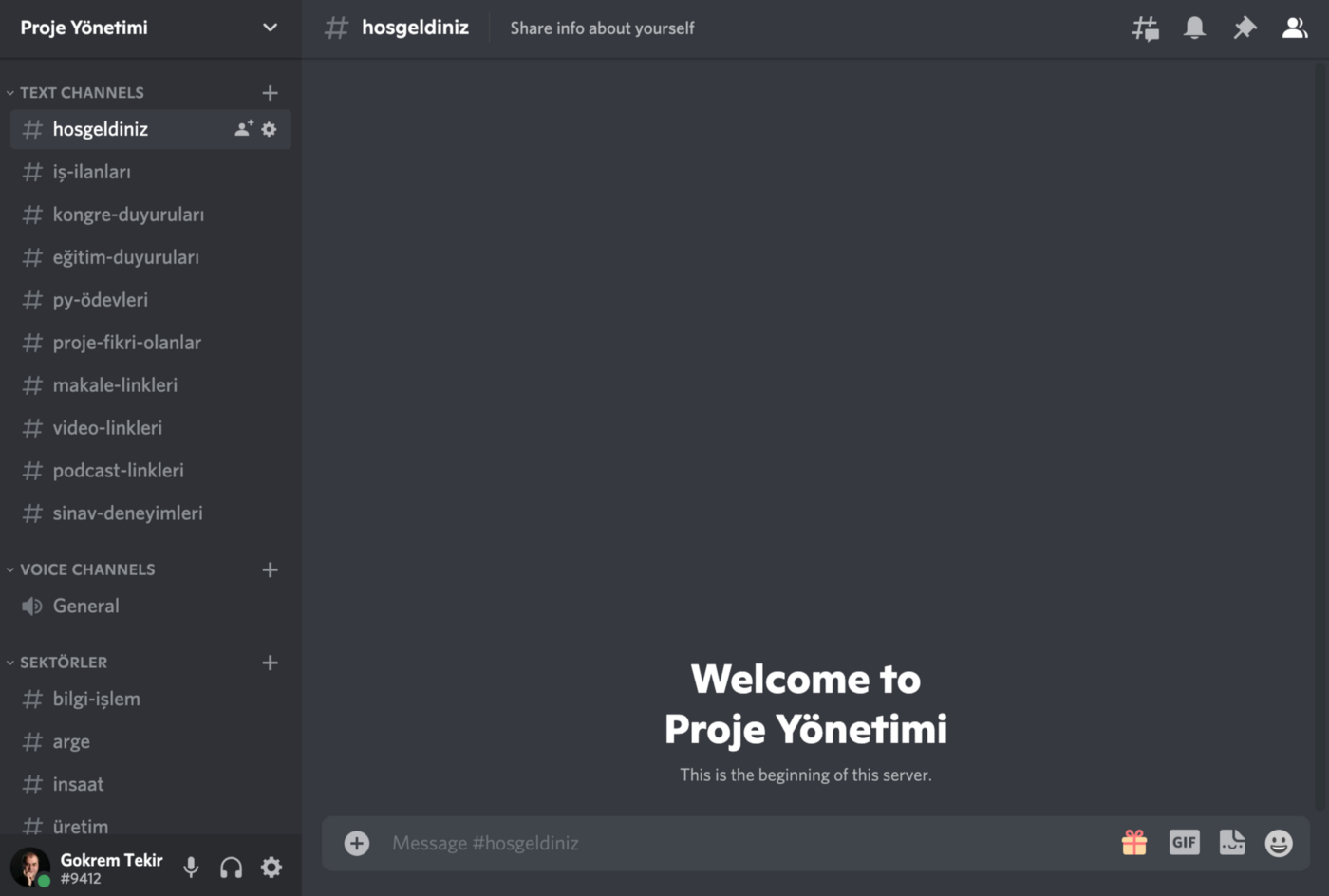
Discord Kanal’ı herkese açıktır ve proje yönetimi temelinde herkes istediğini paylaşabilecektir. Umarım, proje yönetimine gönül verenler için faydalı olur.
Şimdilik ana başlıklar aşağıdaki gibi. Yeni kanal başlıkları için lütfen öneride bulunun.
Projelerde eğitim planı geliştirmenin ilk adımı, paydaşların ihtiyaç duyacağı gerekli becerileri belirlemektir.
Eğitimler, bilgi birikimi aktarmak, kabiliyet gelişimi sağlamak veya geçmiş deneyimleri aktarmak şeklinde olabilir.
Farklı paydaşların farklı eğitim ihtiyaçları olabilir. Bazıları, eğitimde öğrendiklerini hemen kullanırken, bazılar işi denetlemek için eğitimden yararlanıyor olabilir.
Proje ekip üyelerine verilecek eğitimler, projenin hedefleri şekillendikçe, netleşmeye başlar. Özellikle, müşterinin sektörüne yönelik kavramlar, iş yapış şekilleri, yasal kısıtlar, sektör dinamikleri gibi faktörler eğitimlerin içeriğini oluşturur. Özetle, proje ihtiyaçlarının anlaşılması, hangi konularda eğitim gerektiğinin belirlenmesi için ön koşuldur.
Eğitim, ekip üyelerinin yeni veya geliştirilmiş beceri, bilgi kazandığı bir etkinliktir. Konular, yönetim yaklaşımları, teknik veya farkındalığı artırıcı içerikler olabilir.
Eğitim birçok şekilde verilebilir. Kapsamlı bir liste olmasa da, bazı eğitim sunum modelleri şunlardır:
• Eğitmen liderliğindeki sınıf eğitimi
• Sanal sınıf eğitimi
• Kendi hızınızda e-öğrenme
• Belge incelemeleri
• Etkileşimli simülasyonlar
• İşbaşı eğitimi
Paydaşların eğitim ihtiyaçları ve öğrenme biçimleri farklı olacaktır ayrıca bütçe kısıtı da farklı öğrenme araçlarını gündeme getirecektir.
Son kullanıcı eğitimleri, yeni sisteme geçişe yakın zamanda yapılması gerektiğinden, zaman planlamada dikkatli olmak gerekir.
Eğitim Boşluk Analizi: Projenizin paydaş analizine dayanarak, mevcut becerileri ve gerekli becerileri nelerdir?
Müşterinin iş akışlarında ve rollerinde yapacağı değişiklikleri değerlendirerek eğitim eksikliklerini belirlemelisiniz.
Ekip üyeleri de, projeyi hızlandırmak veya proje ortamını daha detaylı anlamak için eğitim alabilir.
Bütün bu değerlendirmeler sonunda, eğitim planı hazırlanır; Bu planda hangi paydaşın, hangi konuda eğitim alması gerektiği, eğitimlerin ne zaman yapılacağı, eğitimin güncel tutulması için tekrar sıklığı gibi faktörler tanımlanır.
Eğitim Seçenekleri
Eğitmen liderliğinde eğitim: Sınıf veya sanal eğitim ortamında canlı eğitmen liderliğinde eğitim verme şeklidir.
Kendi hızınızda e-öğrenme: Öğrencilere çevrimiçi olarak sunulan ve genellikle zengin medya videosu, benzetilmiş laboratuvar egzersizleri içeren bir tarayıcı kullanılarak tüketilen e-öğrenme içeriğidir. Bu yaklaşımın en büyük faydası pek çok öğrenciye ulaşma imkanı olmasıdır.
Belge incelemeleri: Basit bilgi aktarımı için, ilgili belgeleri paylaşmak yeterli olabilir.
Proje personeli ve müşteri paydaşları için yapılacak eğitimlerin maliyetleri proje bütçesini hesaplarken mutlaka düşünülmelidir.
Bu maliyetler şunları içerebilir:
• İçerik oluşturma ve düzenleme maliyetleri
• İçerik barındırma ve dağıtım maliyetleri
• Eğitmen maliyeti
* Eğitim malzemesi çoğaltma ve dağıtma
• Eğitim salonu maliyetleri
Lojistik maliyetleri (konaklama, yiyecekler)
Proje yöneticisi zaman çizelgesi içinde , eğitim tarihi ve yerini duyurması gerekir.
Eğitimin paydaşlara yayınlanması, kayıt, kayıt onayı, hatırlatma mesajı gönderme ve paydaş katılımını doğrulamak için bir mekanizma kurmak gerekebilir.
Son kullanıcı eğitimlerinde, içeriğin hazırlanması ve eğitim verilmesi aktiviteleri, projenin kritik yolundaysa, projenin teslimini geciktirebileceği için zaman planına büyük özen gösterilmelidir.








 Gökrem Tekir Blog Sayfası