Tag: pmi
PMBOK® 8 Neden Bir “Standart” Olarak Yazıldı?

Gökrem Tekir yorumuyla “Standart” kavramının açıklaması
Uzun yıllar boyunca PMBOK, proje yönetimi denildiğinde akla gelen en temel başvuru kaynağıydı. Süreçler, girdiler, çıktılar, araçlar ve teknikler üzerinden ilerleyen bu yaklaşım; özellikle PMP sınavına hazırlananlar için net ve öğretici bir çerçeve sundu. Ancak zamanla sahada çok net bir soru ortaya çıktı: Aynı süreçleri uygulayan projeler neden birbirinden tamamen farklı sonuçlar üretiyordu?
Bu soru, aslında PMBOK 8’in neden yazıldığını da açıklıyor.
PMBOK® Guide 8. baskı ile birlikte PMI, proje yönetimine bakış açısında belirgin bir yön değişikliğine gitti. Odak noktası artık sadece “nasıl yapılır” sorusu değil; “neden yapıyoruz” sorusu oldu. Bu nedenle kitap, bir rehber olmanın ötesine geçerek özellikle “Standard for Project Management” ifadesini öne çıkardı.
Buradaki “standart” kavramı, çoğu zaman yanlış anlaşılıyor. PMBOK 8, herkese aynı yöntemi dayatan bir yaklaşım sunmuyor. Aksine, her projenin kendi bağlamı içinde değerlendirilmesi gerektiğini söylüyor. Ancak aynı zamanda, her projenin organizasyonun değer üretme sisteminin bir parçası olduğunu net bir şekilde vurguluyor. Yani proje, kendi başına izole bir iş değil; organizasyonel hedeflerle doğrudan ilişkili bir yapı.
Ben PMBOK 8’deki bu değişimi şu şekilde yorumluyorum: PMI artık proje yöneticilerine ne yapmaları gerektiğini adım adım anlatmak yerine, nasıl düşünmeleri gerektiğini tanımlıyor. Çünkü standart dediğimiz şey bir kontrol listesi değildir. Standart, ezberlenecek slaytlar da değildir. Standart, karar verirken hangi zihinsel çerçeveyi kullanacağını bilmektir.
Bu yaklaşım, proje yöneticisini süreçleri takip eden bir uygulayıcı olmaktan çıkarıp, değer üreten bir karar verici konumuna taşır. PMBOK 8’in en kritik katkısı da tam olarak burada ortaya çıkar.
Sahadan sık karşılaşılan bir örnek üzerinden düşünelim. Bir proje zamanında tamamlanmıştır, bütçe aşılmamıştır ve belirlenen kapsam eksiksiz teslim edilmiştir. Klasik proje yönetimi bakış açısıyla bakıldığında proje başarılıdır. Ancak sponsor toplantısında şu cümle gelir: “Evet, proje bitti ama beklediğimiz etkiyi yaratmadı.”
Bu noktada PMBOK 8’in getirdiği bakış açısı devreye girer. Asıl soru artık şudur: Bu proje organizasyon için gerçekten hangi değeri üretti? Zaman, bütçe ve kapsam hedeflerine ulaşmak tek başına yeterli midir, yoksa proje çıktılarının yarattığı etkiyi de değerlendirmek gerekir mi?
PMBOK 8’in “standart” vurgusu, bu soruların sorulmasını zorunlu kılar.
En sık yapılan hatalardan biri, PMBOK 8’i hâlâ eski alışkanlıklarla okumaya çalışmaktır. Yeni süreçler var mı, sınavda hangi kavramlar sorulacak, kaç tane çıktı eklendi gibi sorularla yaklaşıldığında, PMBOK 8’in özü kaçırılır. Çünkü bu baskı, süreç odaklı bir kitap olmaktan çok, düşünce odaklı bir standarttır.
Bugün PMP sınavı da gerçek projeler de şunu ölçmeye çalışıyor: Süreçleri ezbere biliyor musunuz, yoksa duruma göre doğru yaklaşımı seçebiliyor musunuz? PMBOK 8’in “Standard for Project Management” bölümü, bu zihniyet dönüşümünün temelini oluşturur.
Bu yazı, “PMBOK® 8 – Gökrem Tekir Yorumuyla” serisinin ilk adımıdır. Serinin devamında, PMBOK 8’in neden tanımlarla başladığını ve “Key Terms and Concepts” bölümünde hangi kavramları özellikle sabitlemek istediğini ele alacağım.
Proje Yönetim Ofisi Nedir? Başarı İçin Önemi
Ben Gökrem Tekir. 20 yıldan uzun bir süredir proje yönetimi, Proje Yönetim Ofisi yapılanmaları ve kurumsal dönüşüm alanlarında çalışan bir proje yönetimi danışmanıyım. Bu yazıda, Proje Yönetim Ofisi nedir, neden kurulur ve şirketlere gerçekte nasıl değer katar sorularını sade, net ve pratik bir bakış açısıyla ele alıyorum.
Proje Yönetim Ofisi kavramı birçok organizasyonda hâlâ yanlış anlaşılıyor. Çoğu kişi bu yapıyı sadece rapor isteyen, formlar hazırlatan ya da projelerin önüne bürokratik engeller koyan bir birim olarak görüyor. Oysa doğru kurgulanmış bir Proje Yönetim Ofisi, bir şirketin stratejik omurgasıdır ve projelerden elde edilen değeri doğrudan artırır.
Proje Yönetim Ofisi Nedir?
Proje Yönetim Ofisi, bir organizasyonda projelerin nasıl yönetileceğini tanımlayan, standartları belirleyen, proje yöneticilerini destekleyen ve proje performansını bütünsel olarak izleyen yapıdır.
Bu Ofisin temel amacı, projelerin daha öngörülebilir, kontrol edilebilir ve başarılı olmasını sağlamaktır. Bir bakıma Proje Yönetim Ofisi, organizasyon içindeki tüm projelerin aynı dili konuşmasını sağlayan merkez noktadır. Böylece projeler kişilere bağımlı olmaktan çıkar, kurumsal bir yapıya kavuşur.
Proje Yönetim Ofisi Şirketlere Nasıl Değer Katar?
Proje Yönetim Ofisinin şirkete kattığı değer, çoğu zaman tek tek projelerden değil, projelerin toplam etkisinden ortaya çıkar.
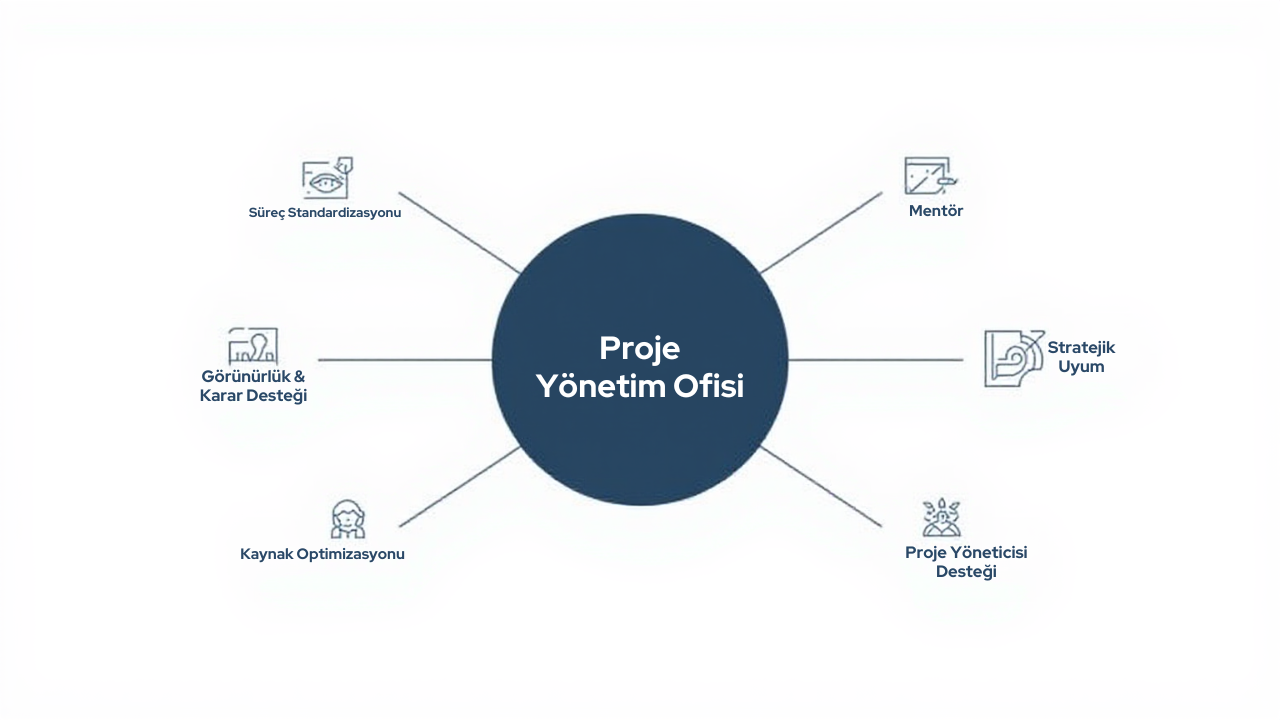
İlk ve en önemli katkı süreç standardizasyonudur. Her proje yöneticisinin kendi yöntemini kullandığı bir ortamda, projeler arasında kıyaslama yapmak neredeyse imkânsızdır. Ofis, ortak bir metodoloji oluşturarak projelerde tutarlılık sağlar. Bu da hem hızın artmasına hem de kalite seviyesinin yükselmesine katkı verir.
İkinci önemli katkı görünürlüktür. Üst yönetim, projelerde neler olup bittiğini net bir şekilde göremiyorsa sağlıklı karar alamaz. Proje Yönetim Ofisi, projelerin durumunu tek bir merkezden izler ve yönetime doğru, zamanında ve anlamlı bilgiler sunar. Bu sayede riskler erken fark edilir, maliyet sapmaları kontrol altına alınır ve önceliklendirme daha sağlıklı yapılır.
Bir diğer kritik katkı ise kaynak optimizasyonudur. Aynı anda çok sayıda proje yürütülen organizasyonlarda, insan kaynağı, zaman ve bütçe genellikle verimsiz kullanılır. Proje Yönetim Ofisi, hangi kaynağın hangi projede, ne zaman ve ne kadar süreyle çalışacağını planlayarak aşırı yüklenmenin önüne geçer. Sonuç olarak daha sürdürülebilir bir çalışma ortamı oluşur.
Proje Yönetim Ofisi Sadece Raporlama Birimi midir?
Hayır. Bu, Proje Yönetim Ofisi ile ilgili en yaygın yanlış algılardan biridir.
Ofis, proje yöneticileri için bir destek merkezidir. Metodoloji eğitimleri verir, şablonlar ve rehberler sunar, proje yönetimi araçlarının doğru kullanımını sağlar ve zorlanan proje yöneticilerine mentorluk yapar. Bazı organizasyonlarda Proje Yönetim Ofisi, proje yöneticilerinin atanmasında ve gelişim planlarının oluşturulmasında da aktif rol alır.
Yani bu yapı, sadece projeleri değil, proje yöneticilerini de güçlendiren bir mekanizma olarak çalışır.
Proje Yönetim Ofisleri Neden Başarısız Olur?
Birçok Proje Yönetim Ofisi, birkaç yıl içinde kapatılır ya da etkisiz hale gelir. Bunun en temel nedeni, kuruluş amacının net olmamasıdır. Ofisin neden var olduğu, hangi probleme çözüm ürettiği ve nasıl bir değer yaratacağı açıkça tanımlanmadığında, kısa sürede “rapor üreten bir sekreterya” olarak algılanmaya başlar.
Bir diğer önemli neden ise aşırı bürokrasidir. Proje Yönetim Ofisinin görevi insanları evrak altında boğmak değildir. Fazla süreç, fazla kontrol ve gereksiz formlar, bu yapıyı projelerin önünde bir engel haline getirir. Bu noktada proje ekipleri Ofise karşı direnç geliştirmeye başlar.
Başarılı Proje Yönetim Ofislerinin Ortak Özellikleri
Başarılı örneklere baktığımızda ortak bir tablo görürüz. Bu Proje Yönetim Ofisleri, organizasyonun gerçek ihtiyaçlarına göre tasarlanmıştır. Yalındır, esnektir ve değer üretmeye odaklanır.
Yönetimle güçlü ilişkiler kurar, proje ekiplerinin güvenini kazanır ve “zorunlu bir yapı” değil, gerçekten kullanılan bir araç haline gelir. Başarılı bir Ofis, projeleri kontrol eden değil, projelerin başarı şansını artıran bir iş ortağı gibi çalışır.
Sonuç: Proje Yönetim Ofisi Gerçekten Ne Değer Katar?
Proje Yönetim Ofisinin gerçek değeri, projeleri tek tek iyileştirmesinden değil, organizasyonun proje yapma biçimini dönüştürmesinden gelir. Doğru kurgulanmış bir Proje Yönetim Ofisi; daha iyi kararlar, daha verimli kaynak kullanımı ve daha yüksek proje başarısı demektir.
Bir sonraki yazıda, Proje Yönetim Ofisi türlerini ele alacağım. Destekleyici, kontrol edici, yönlendirici ve hibrit Ofis modellerinin nasıl çalıştığını ve hangi organizasyonlar için daha uygun olduğunu detaylıca inceleyeceğiz. Eğer Proje Yönetim Ofisi kurmayı düşünüyorsanız ya da mevcut yapıyı geliştirmek istiyorsanız bu seri size net bir yol haritası sunacaktır.
Son olarak, bu konuda hazırlamış olduğum ve sanal asistanım tarafından sunulan videoyu da aşağıda bulabilirsiniz. Umarım, beğenirsiniz.
Başarılı Projelerin Sırrı: Ekip Yönetimi, Paydaşlar ve Liderlik
Proje Ekibi
PMP Sertifikasının Diğer Sertifikalara Göre Önemi
Günümüz iş dünyasında proje yönetimi becerileri giderek daha fazla talep görmektedir. Şirketler, projelerini daha verimli yönetmek, bütçe ve zaman hedeflerine sadık kalmak ve riskleri minimize etmek için profesyonel proje yöneticilerine ihtiyaç duymaktadır. Bu noktada, Project Management Professional (PMP®) sertifikası, proje yönetimi alanında en prestijli ve global olarak en çok tanınan sertifikalardan biri olarak öne çıkmaktadır. Peki, PMP sertifikası neden diğer proje yönetimi sertifikalarına göre daha önemli bir yere sahiptir? İşte PMP sertifikasını öne çıkaran başlıca faktörler:
1. Global Tanınırlık ve Güvenilirlik
PMP sertifikası, Project Management Institute (PMI®) tarafından verilen ve dünya çapında tanınan bir sertifikadır. Dünya genelinde 1.5 milyondan fazla PMP sertifikalı profesyonel bulunmaktadır ve birçok uluslararası şirket, proje yöneticilerinde bu sertifikayı zorunlu bir kriter olarak görmektedir. PMP, ISO 9001:2015 sertifikasına sahip olup kalite standartlarına uygunluğu kanıtlanmış bir belgedir. Bu, PMP sertifikasının güvenilirliğini artıran önemli bir faktördür.
2. PMP, Pratik ve Kapsamlı Bir Çerçeve Sunar
PMP sertifikası, PMBOK® Guide (Project Management Body of Knowledge) temel alınarak oluşturulmuştur. PMP sınavı;
- Çevik (Agile), öngörücü (Predictive) ve hibrit proje yönetim metodolojilerini kapsar,
- En iyi uygulamaları ve gerçek hayatta uygulanabilir çözümleri öğretir,
- İletişim, liderlik, risk yönetimi, paydaş yönetimi ve stratejik uyum gibi alanlarda derinlemesine bilgi verir.
Bu kapsamlı yaklaşım, PMP’yi birçok spesifik ve dar kapsamlı proje yönetimi sertifikasından ayıran en büyük farklardan biridir.
3. PMP Sahiplerine Daha Yüksek Maaş ve İş Fırsatları
PMI tarafından yayınlanan Earnings Power: Project Management Salary Survey raporuna göre, PMP sertifikalı profesyoneller PMP’siz meslektaşlarına göre ortalama %20 daha yüksek maaş almaktadır. PMP sertifikası, kariyer ilerlemesini hızlandıran ve global pazarda rekabet avantajı sağlayan bir unsurdur. Özellikle büyük şirketlerde ve uluslararası organizasyonlarda proje yöneticileri için PMP sertifikasına sahip olmak, işe alım sürecinde önemli bir avantajdır.
4. PMP, Deneyim ve Uzmanlığı Kanıtlar
Diğer birçok sertifikadan farklı olarak PMP’ye sahip olabilmek için yalnızca sınavı geçmek yeterli değildir. PMP sertifikası almak için adayların;
- En az 36 ila 60 ay arasında proje yönetimi deneyimine sahip olması,
- 35 saatlik proje yönetimi eğitimi almış olması,
- Zorlu bir sınavı başarıyla tamamlamış olması gerekir.
Bu kriterler, PMP sertifikasının yalnızca teorik bilgiye değil, aynı zamanda gerçek dünya deneyimine dayandığını gösterir. PMP sertifikası, kişinin sadece metodolojileri bilmekle kalmayıp, bunları uygulama yetkinliğine sahip olduğunu da kanıtlar.
5. PMP, Proje Yönetimi Kariyerinde Sürekli Öğrenmeyi Destekler
PMP sertifikası alındıktan sonra, profesyonellerin her üç yılda bir 60 PDU (Professional Development Unit) toplamasıgerekmektedir. Bu, PMP sertifikalı kişilerin sürekli olarak proje yönetimi alanındaki yeni trendleri takip etmelerini ve kendilerini geliştirmelerini sağlar. PMP’nin sunduğu bu sürekli öğrenme gerekliliği, diğer birçok sertifikaya kıyasla onu daha dinamik ve güncel bir sertifika haline getirir.
Diğer Sertifikalar ile PMP’nin Karşılaştırılması
| Sertifika | Veren Kuruluş | Kapsam | PMP’ye Göre Farklılık |
|---|---|---|---|
| PMP (Project Management Professional) | PMI | Öngörücü, Çevik, Hibrit Proje Yönetimi | Küresel standart, en prestijli proje yönetimi sertifikası |
| CAPM (Certified Associate in Project Management) | PMI | Giriş seviyesi, temel bilgiler | PMP’nin daha az deneyim gerektiren versiyonu |
| PRINCE2 Practitioner | AXELOS | Süreç tabanlı proje yönetimi | Daha çok Avrupa ve İngiltere’de tercih edilir, PMP kadar geniş kapsamlı değildir |
| CSM (Certified Scrum Master) | Scrum Alliance | Çevik proje yönetimi (Scrum) | Sadece Scrum metodolojisine odaklanır, PMP kadar kapsamlı değildir |
| AgilePM | APMG International | Çevik proje yönetimi | PMP’nin çevik kapsamı kadar detaylı değildir |
Sonuç: PMP Neden Önemli?
PMP sertifikası, proje yönetimi alanında en kapsamlı, en çok talep edilen ve en prestijli sertifikalardan biridir. Küresel tanınırlığı, maaş avantajları, geniş metodoloji kapsamı ve sürekli gelişimi teşvik etmesi nedeniyle, proje yönetimi kariyerinde ilerlemek isteyen profesyoneller için büyük bir fark yaratır. PMP sertifikasına sahip olmak, yalnızca bir unvan değil, aynı zamanda proje yönetiminde ustalık ve liderlik anlamına gelir.
Eğer proje yönetimi alanında başarılı bir kariyer hedefliyorsanız, PMP sertifikası size global fırsatlar ve yüksek maaş avantajları sunan en güçlü araçlardan biri olacaktır.
PMP Sertifikasına en kısa sürede ulaşmak için İstanbul Kurumsal Gelişim’in her ay düzenli açtığı eğitimlere katılabilirsiniz. Detaylı bilgi için aşağıdaki linki takip edin.
PMP Questions (71-80)

Subscribe to continue reading
Become a paid subscriber to get access to the rest of this post and other exclusive content.
11- PMP Questions – 26 – 30
10- PMP Questions 21-25
9- PMP Questions Set
PMP Questions 31-40

Question 31
In managing rates and resource assignments in an Agile virtual team, what principle should guide the project manager’s approach?
A) Prioritizing the allocation of high-cost resources to the most complex tasks, under the assumption that a higher rate is a direct indicator of a resource’s ability to handle complexity and deliver high-quality outcomes.
B) Focusing on minimizing the use of external resources to reduce overall project costs, even if it means compromising on the breadth of skills or experience available to the project, under the assumption that internal resources always provide better value.
C) Balancing the cost of resources with the value they bring to the project, considering their skills, experience, and the strategic importance of their contributions, to ensure an optimal return on investment and project success.
D) Assigning resources primarily based on their geographic proximity to the majority of the team or the project stakeholders, to facilitate easier coordination and potentially reduce costs associated with time zone differences.
Erişim elde etmek için abone olun
Buna benzer içerikleri daha fazla okumak için bugün abone olun.
Question 32
During a project, your Agile team realizes that the workload is unevenly distributed, with some members feeling overwhelmed while others are underutilized. What Agile technique should you use to rebalance the team workload effectively?
A) Redefine team roles and responsibilities to match the current workload without consulting the team.
B) Implement a strict task assignment system to evenly distribute tasks among team members.
C) Encourage team members to work overtime to complete their tasks faster.
D) Conduct a Retrospective meeting to discuss workload balance and collaboratively find solutions.
Erişim elde etmek için abone olun
Buna benzer içerikleri daha fazla okumak için bugün abone olun.
Question 33
Your Agile team is diverse, with members speaking multiple languages, which has led to some communication challenges. What strategy should you adopt to improve communication and ensure project success?
A) Implement daily stand-ups to encourage regular communication and identify any misunderstandings early.
B) Require all team members to communicate only in the most common language.
C) Use only written communication to avoid language barriers.
D) Assign a translator to the team to facilitate communication during meetings.
Erişim elde etmek için abone olun
Buna benzer içerikleri daha fazla okumak için bugün abone olun.
Question 34
What is the primary advantage of leveraging technology solutions to facilitate face-to-face communication in virtual teams following a predictive approach?
A) Significantly reducing the reliance on traditional project documentation by shifting most of the project communications and updates to live video calls, thereby streamlining the information dissemination process.
B) Potentially increasing the project’s overall budget due to the costs associated with implementing state-of-the-art video conferencing tools and technologies, which, while expensive, are deemed necessary for enhancing team interaction.
C) Enhancing team cohesion and understanding through improved interpersonal communication, as face-to-face interactions, even if virtual, help in building relationships and clarifying complex project issues more effectively than text-based communications.
D) Simplifying the entire process for submitting and approving change requests by discussing them in real-time during video calls, thus avoiding the bureaucratic paperwork typically involved in predictive project environments.
Erişim elde etmek için abone olun
Buna benzer içerikleri daha fazla okumak için bugün abone olun.
Question 35
In a predictive project environment, what is the best strategy for assigning responsibilities within a newly formed virtual team?
A) Employing a random task assignment strategy to push team members out of their comfort zones, encouraging them to learn new skills and adapt quickly to unforeseen project challenges, thus fostering a versatile and resilient team.
B) Centralizing decision-making by delegating all critical and complex tasks exclusively to the most senior team members, assuming their experience guarantees the highest quality of work and adherence to project timelines.
C) Allowing team members to select their tasks purely based on personal preference, fostering a democratic and inclusive atmosphere that values individual choice over project needs or strategic fit.
D) Determine assignments based on a detailed assessment of each member’s experience, knowledge, skills, and attitude, ensuring that tasks are aligned with individual strengths and project requirements for maximum efficiency.
Erişim elde etmek için abone olun
Buna benzer içerikleri daha fazla okumak için bugün abone olun.
Question 36
What is the key benefit of using information radiators in an Agile virtual team?
A) Completely eliminating the need for daily stand-up meetings by providing an always-up-to-date digital dashboard that tracks project progress, thereby freeing up more time for development activities.
B) Increasing transparency and offering quick access to vital project information, such as current sprint progress and existing impediments, thus fostering a culture of openness and continuous improvement across the team.
C) Serving as the sole basis for evaluating team performance and individual contributions, thereby simplifying the appraisal process by focusing on quantifiable metrics displayed on the information radiator.
D) Replacing traditional digital communication tools with physical, highly visible boards placed in common areas of the virtual workspace, to ensure that every team member has uninterrupted access to project updates.
Erişim elde etmek için abone olun
Buna benzer içerikleri daha fazla okumak için bugün abone olun.
Question 37
You have recently been appointed as the project manager for a new city park development project. The project will not only include playgrounds and walking paths but also a small amphitheater for community events.
In the early stages of this project, who among the following should you prioritize as a key stakeholder to engage with?
A. Local government regulatory bodies, essential for ensuring compliance with local laws and regulations, their early involvement can significantly impact project approvals and progression.
B. Playground equipment suppliers, crucial for sourcing materials, but their engagement is more tactical and can be addressed in later project phases.
C. Internal financial analysts of your organization, important for budgeting and financial planning, but their role is often more internal and less critical in the initial stages.
D. Media outlets for publicity of the project, important for public relations, but their involvement is not critical in the early stages of project planning.
Erişim elde etmek için abone olun
Buna benzer içerikleri daha fazla okumak için bugün abone olun.
Question 38
In the context of team building, why is it important to evaluate a team holistically?
A) To exclusively focus on the strengths of the team, disregarding potential areas for improvement.
B) To understand team dynamics, including strengths, weaknesses, and preferences, without considering how these factors interplay.
C) Because it is a standard procedure in all project management methodologies, overlooking the specific needs of individual teams.
D) To identify team members to be removed from the project, solely based on their perceived weaknesses.
Erişim elde etmek için abone olun
Buna benzer içerikleri daha fazla okumak için bugün abone olun.
Question 39
In a project team working on a new product launch, a disagreement arises between the marketing and engineering teams about the product’s features. The marketing team wants advanced features for better market appeal, while the engineering team is concerned about the feasibility and time constraints of these features.
Which option below best represents the role of conflict management?
A) Ignoring conflicts to maintain project harmony.
B) Addressing conflicts before they escalate.
C) Letting conflicts resolve themselves.
D) Concentrating solely on the technical aspects of conflicts.
Erişim elde etmek için abone olun
Buna benzer içerikleri daha fazla okumak için bugün abone olun.
Question 40
In a project with a multicultural team, communication issues have arisen due to language barriers and cultural misunderstandings. As the project manager, you aim to address these challenges. Which of the following strategies would be least effective in improving team cohesion and performance?
A) Implementing regular cross-cultural training sessions focused on improving communication and understanding among team members.
B) Creating a mentorship program pairing team members from different cultural backgrounds to promote mutual understanding and collaboration.
C) Establishing a communication protocol that includes regular check-ins and feedback sessions to address and resolve cultural misunderstandings promptly.
D) Hiring a professional translator to assist with communication between team members who do not share a common language.
Erişim elde etmek için abone olun
Buna benzer içerikleri daha fazla okumak için bugün abone olun.
8- PMP Questions Set
PMP Questions 21-30

Question 21
The project you’re managing involves collaboration between teams from two different companies with distinct corporate cultures. To unify the teams, you recognize the need to establish common team norms. What approach do you take to establish effective team norms for this collaborative project?
A) Holding a joint workshop where team members from both companies can contribute to the creation of shared norms, ensuring buy-in from all participants.
B) Drafting a set of norms based on your company’s culture and enforcing them across the combined team to maintain consistency.
C) Allowing each company to follow its own set of norms to avoid conflict, relying on project milestones to keep the teams aligned.
D) Deciding that establishing team norms is too time-consuming and unnecessary, focusing instead on individual accountability for project deliverables.
Erişim elde etmek için abone olun
Buna benzer içerikleri daha fazla okumak için bugün abone olun.
Question 22
During the procurement process, the project manager notices that the supplier is unwilling to agree on specific quality requirements. What should be the project manager’s next step?A) Continue with the procurement process despite the supplier’s unwillingness to agree on specific quality requirements, potentially compromising the project’s quality standards but avoiding delays in the procurement timeline
B) Seek intervention from senior management to leverage their authority and experience in negotiating with the supplier, possibly leading to a resolution that upholds the project’s quality requirements.
C) Engage in further negotiations to explore alternative terms, such as price adjustments or additional services, that could offset the impact of not meeting the specified quality requirements.
D) Collaborate with the project team to generate creative solutions or identify alternative suppliers who can meet the quality requirements, ensuring the project’s standards are maintained.
Erişim elde etmek için abone olun
Buna benzer içerikleri daha fazla okumak için bugün abone olun.
Question 23
A project manager is overseeing a project where the external vendor has consistently failed to meet the SLA terms. What should be the project manager’s immediate action?
A) Consider ending the contractual relationship with the vendor due to their consistent failure to meet the SLA terms, potentially seeking a new vendor who can better fulfill the service expectations.
B) Initiate discussions with the vendor to renegotiate the SLA terms, aiming for more realistic expectations or improved service levels that the vendor can consistently meet.
C) Record the instances where the vendor failed to meet the SLA terms and engage in a constructive dialogue to identify the root causes and collaboratively develop a plan to prevent future failures.
D) Choose not to address the minor SLA breaches, focusing instead on more critical aspects of the project, as long as the overall project progress and outcomes are not significantly affected.
Erişim elde etmek için abone olun
Buna benzer içerikleri daha fazla okumak için bugün abone olun.
Question 24
The project manager is using the MoSCoW technique for prioritization. Suddenly, a stakeholder demands that a ‘Could Have’ feature be upgraded to ‘Must Have.’ How should the project manager handle this situation?
A) Promptly reclassify the ‘Could Have’ feature to ‘Must Have’ based on the stakeholder’s demand, potentially impacting the project scope and resource allocation.
B) Conduct a thorough analysis of how the change in prioritization will affect the project’s scope, timeline, and budget, ensuring that any decision made is informed and balanced.
C) Decline the stakeholder’s request to maintain the original prioritization, emphasizing the importance of adhering to the established project plan and priorities.
D) Seek input from other stakeholders to gauge their perspectives on the proposed change in prioritization, ensuring that the decision is well-rounded and considers multiple viewpoints.
Erişim elde etmek için abone olun
Buna benzer içerikleri daha fazla okumak için bugün abone olun.
Question 25
The project’s performance report shows a significant deviation in actual costs from the planned budget. What should be the project manager’s first course of action?
A) Revise the project budget to accommodate the higher actual costs, ensuring that the project remains financially viable while addressing the cost overruns.
B) Conduct a detailed analysis to identify why the actual costs deviated from the planned budget and take appropriate corrective measures to prevent similar discrepancies in the future.
C) Communicate the cost overrun to the stakeholders and seek additional funding to cover the unexpected expenses, ensuring that the project can continue without financial constraints.
D) Consider scaling back the project scope to reduce costs, ensuring that the project stays within the original budget while still achieving its core objectives.
Erişim elde etmek için abone olun
Buna benzer içerikleri daha fazla okumak için bugün abone olun.
Question 26
After a sprint, the team realizes that their communication practices were ineffective. What should the team do next?
A) Persist with the existing communication practices despite their identified inefficiencies, potentially leading to continued miscommunications but avoiding the disruption of changing practices mid-sprint.
B) Attribute the communication practices’ ineffectiveness to the team members’ failure to adhere to them, overlooking the possibility that the practices themselves might be flawed or inadequate.
C) Choose not to address the communication practices’ shortcomings, fearing that changes might lead to confusion among team members, even though this might result in ongoing communication challenges.
D) Update their communication practices incorporating the insights gained from the sprint’s experiences, aiming to enhance the effectiveness of communication in the subsequent sprints.
Erişim elde etmek için abone olun
Buna benzer içerikleri daha fazla okumak için bugün abone olun.
Question 27
In an agile project, the customer wants to add new features to the product backlog, which will impact the agreed performance levels. How should the team approach this situation?
A) Politely decline the customer’s request, emphasizing the importance of sticking to the original project scope to ensure timely delivery and avoid unnecessary complications.
B) Accept the new features but inform the customer that additional resources or time will be required, presenting a clear plan for how the team will accommodate these changes.
C) Conduct a thorough analysis of the new features to determine their impact on the project’s performance levels and overall objectives, and then negotiate a compromise with the customer.
D) Immediately incorporate the new features into the project backlog, reassessing the project’s performance levels and resource allocation to accommodate these changes without compromising project integrity.
Erişim elde etmek için abone olun
Buna benzer içerikleri daha fazla okumak için bugün abone olun.
Question 28
A key team member is unexpectedly unavailable due to personal reasons. How should the project manager handle the situation to minimize the impact on the project schedule?
A) Pause or delay the tasks assigned to the unavailable team member until they return, potentially impacting the project timeline but maintaining the original team structure.
B) Distribute the tasks of the unavailable team member among other team members, which may lead to increased workload and potential burnout but keeps the project on schedule.
C) Revise the resource calendar to reflect the team member’s unavailability, explore options for alternative resources, or adjust the project schedule to accommodate the change without compromising the project’s progress.
D) Implement a risk response plan to address the unavailability of the team member, focusing on proactive measures to mitigate potential delays and maintain project momentum without disrupting the existing team dynamics.
Erişim elde etmek için abone olun
Buna benzer içerikleri daha fazla okumak için bugün abone olun.
Question 29
A project manager in a luggage manufacturing company needs to explore new business opportunities and present three proofs of concepts (POCs) to the executive team. Sales are declining rapidly, putting the company’s future at risk. The project team consists of 15 stakeholders from various parts of the organization, selected for their independent thinking. They have differing opinions on the best opportunities, leading to frequent disagreements.
To address the diverse viewpoints, the project manager opts for an agile approach to quickly establish a shared understanding and identify the most promising solutions to present to the executive team. Which two approaches should the project manager consider? (Choose two)
A) Educate stakeholders on creating user stories and story maps to share their ideas with the group and collectively select the top three for developing the POCs.
B) Oversee the work while empowering three agile teams, each comprising five members, to self-organize and brainstorm new business concepts as user stories. These stories will be reviewed at retrospectives and developed iteratively.
C) Distribute a survey to the 15 stakeholders soliciting new business ideas and concepts. Anonymously share all responses and vote on the three most favored ideas.
D) Give priority to the ideas of executive or senior stakeholders. Empower them as team leads of self-organizing agile teams responsible for delivering POCs to the company incrementally.
E) Require each stakeholder to craft a vision statement and use an Extreme Programming (XP) metaphor to explain their best idea. After all stakeholders vote for the top three ideas, develop them as POCs.
Erişim elde etmek için abone olun
Buna benzer içerikleri daha fazla okumak için bugün abone olun.
Question 30
A project will create digital keys for 18,500 employees at an airport. The project management plan states that security clearance data for employees must be verified and updated in a digital security file every 6 months. This is part of the acceptance criteria. In month 3, the project manager discovers that the company hired to maintain the digital security files has filed for bankruptcy.
Which statement describes the status of this project?
A)This project will fail.
B) This project has an issue.
C) This project is noncompliant.
D) This project is high risk.
Erişim elde etmek için abone olun
Buna benzer içerikleri daha fazla okumak için bugün abone olun.
PMP Questions 16-20
Question 16
When managing a virtual team in a predictive project environment, what is the most critical factor to consider for ensuring effective communication across different time zones?
A) Utilizing asynchronous communication tools and establishing a 24-hour response policy to accommodate diverse time zones while ensuring timely progress updates and feedback.
B) Implementing a mandatory policy that requires all team members to work during a specific overlap of hours, regardless of their local time, to foster real-time collaboration and immediate feedback.
C) Organizing daily mandatory video conferencing meetings for all team members to simulate a traditional office environment and enhance team cohesion, despite the inconvenience to some team members due to their local time zones.
D) Strategically assigning tasks based on the geographical proximity of team members to the project manager’s time zone to simplify scheduling and reduce the complexity of managing across multiple time zones.
Become a Member
Question 17
You’re leading a new project to develop an innovative software application. The team comprises members from different departments, each bringing unique skills and experiences. To ensure everyone is aligned from the outset, you decide to create a Team Charter. What is the primary focus when drafting the Team Charter for your project team?
A) Listing the technical specifications of the software application to ensure all developers understand the project requirements.
B) Outlining each team member’s daily tasks for the first month to kickstart the project with clear direction.
C) Establishing shared values, communication guidelines, and conflict resolution methods to foster a collaborative team environment.
D) Documenting a detailed project timeline, including milestones and deadlines, to track project progress effectively.
Erişim elde etmek için abone olun
Buna benzer içerikleri daha fazla okumak için bugün abone olun.
Question 18
Halfway through the project, a significant client request necessitates a shift in project priorities. This change could impact the timeline and resource allocation. You schedule a meeting with key stakeholders and team leads to discuss the way forward. In negotiating the shift in project priorities, what principle should guide your approach?
A) Insisting on the original plan to avoid setting a precedent for client-driven changes, maintaining project scope and deadlines.
B) Focusing solely on the additional revenue the change request brings, prioritizing any tasks that increase project budget.
C) Automatically accepting the client’s request, reallocating resources to new priorities without reviewing the impact on the project’s original goals.
D) Balancing the client’s needs with the project’s scope and resources, seeking a compromise that aligns with team capabilities and project goals.
Erişim elde etmek için abone olun
Buna benzer içerikleri daha fazla okumak için bugün abone olun.
Question 19
Two team members have a disagreement over the best approach to a critical component of the project. Their conflict has begun to affect the morale of the entire team, and delays are imminent if a resolution is not found. As the project manager, how do you facilitate conflict resolution between these team members?
A) Organizing a mediation session where both parties can present their viewpoints, followed by a discussion to find a mutually acceptable solution.
B) Letting them resolve it on their own to foster independence, avoiding any managerial intervention that could stifle team dynamics.
C) Deciding the outcome yourself based on your understanding of the project needs, to expedite resolution and minimize project delays.
D) Encouraging a team vote on the disputed approaches, going with the majority to ensure team cohesion and democratic decision-making.
Erişim elde etmek için abone olun
Buna benzer içerikleri daha fazla okumak için bugün abone olun.
Question 20
Your project team is distributed across multiple time zones, which has led to communication challenges. Important messages are getting lost, and team members feel disconnected from the project’s progress. How do you establish effective communication protocols for your distributed project team?
A) Implementing a 24/7 chat room where team members can drop messages, expecting immediate responses regardless of time zones.
B) Setting up a weekly all-hands meeting at a time that’s only convenient for the headquarters, summarizing project updates.
C) Creating a structured communication plan that includes regular updates, asynchronous communication tools, and scheduled meetings accommodating all time zones.
D) Relying solely on email for all communications, assuming it’s the most straightforward way to keep everyone informed on their own time.
Erişim elde etmek için abone olun
Buna benzer içerikleri daha fazla okumak için bugün abone olun.
PMP Questions Service

Hello everyone,
I have an exciting announcement to share with you today. I’ve been PMP certified since 2004 and have been conducting PMP preparation training for 20 years. Alongside, I’ve worked as a consultant on many projects, giving me a deep understanding of the skills tested in the PMP exam. Leveraging my training and consulting experiences, I’ve started sharing PMP questions on my blog.
With my PMP Questions Service, you can now manage your PMP exam preparation process more effectively and efficiently. For just $19 per month, ($209 per year) you’ll gain access to both current and future PMP exam questions. Each question is accompanied by explanations for both correct and incorrect answers, as well as additional topic explanations related to that question. This allows you to prepare comprehensively for the PMP exam.
Why should you choose my PMP Questions Service?
- Effective Preparation: Practice with questions that simulate the real exam format to enhance your exam strategy.
- Detailed Explanations: Each question comes with explanations for both correct and incorrect answers, as well as additional topic explanations.
- Save Time: Improve your time management skills while solving questions.
- Up-to-date Content: Keep testing yourself with new and current questions every month.
To benefit from my service, simply visit any PMP Question titled content to sign up. Remember, using the right resources is crucial for a successful exam experience. Stay ahead with my PMP Questions Service!
Have questions? Feel free to reach out. I’m here to help.
Wishing you success,
Gökrem Tekir
 Gökrem Tekir Blog Sayfası